Sign-up to receive regular information on the Admissions process, Open Mornings and other Tormead events.
Tormead’s story began 120 years ago as a modest private venture. Today, it stands as a thriving, highly respected independent school — a testament to vision, resilience, and community spirit.
The school’s roots trace back to Glebefields, a house on Lower Edgeborough Road. Mrs Wilkes, wishing her daughter to study alongside friends, invited Madame Wollaska to teach a small group of girls. In that intimate setting, the foundations of Tormead quietly took hold.
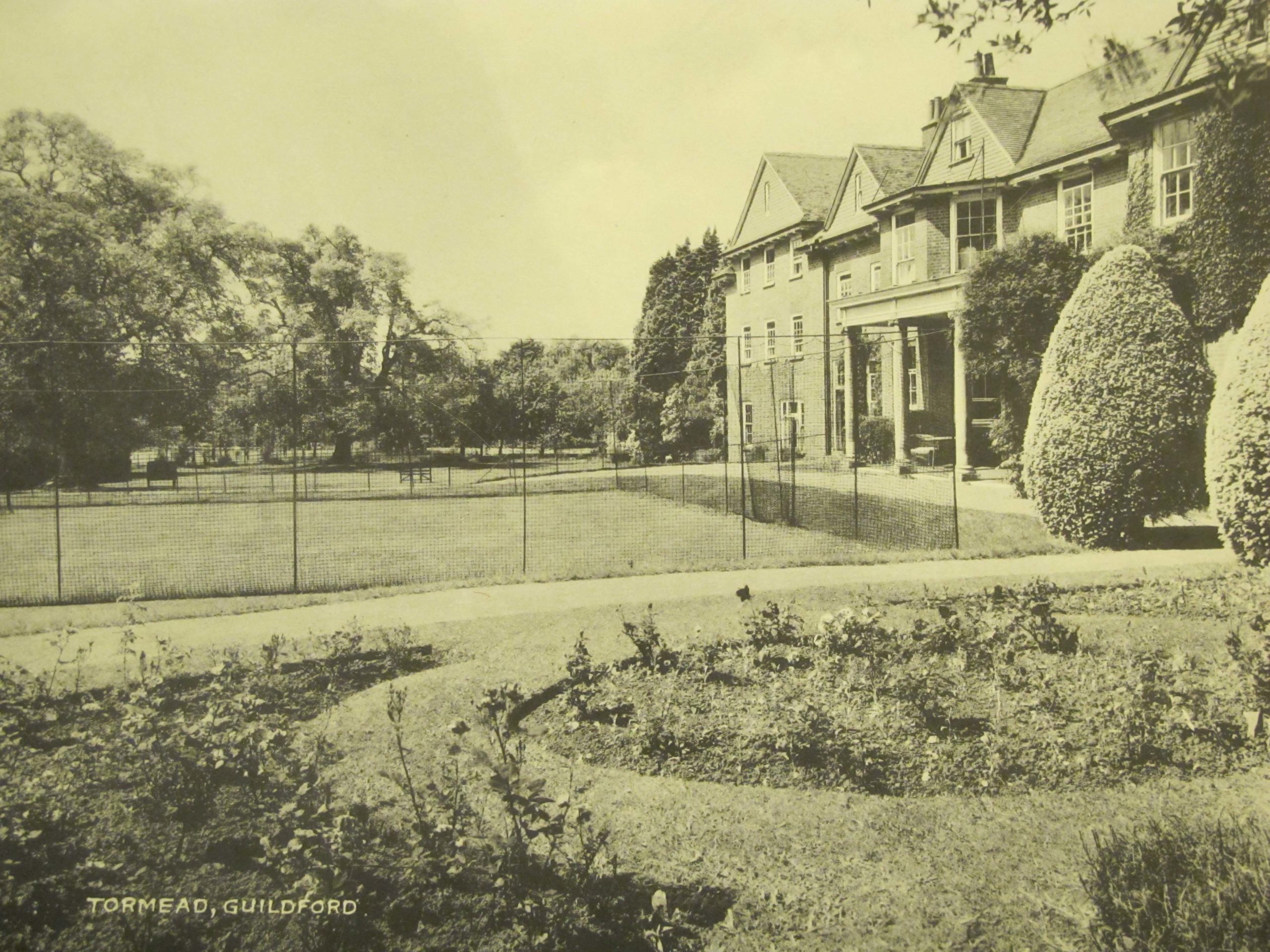
As its reputation grew, so did the need for space. After two relocations, the school settled at its current site in 1914, evolving into a close-knit, slightly eccentric, and happy community.
From its earliest days, Tormead was guided by a succession of formidable Headmistresses who steered the school through challenges — including relocations, financial uncertainty, and the impact of two world wars. Their leadership was unwavering, and their legacy continues to shape the school’s ethos.
During the Second World War, joint Headmistresses Miss Irene Cole and Miss Bertha Williams led the school with strength and compassion. The school had recently been sold to Miss Cole’s brother, Mr Eric Cole, whose company ECKO contributed to Britain’s war effort by developing radar technology.
Despite the upheaval, lessons continued as normally as possible. Air raid shelters, funded by generous parents, provided safety and underscored the school’s enduring community spirit.
The post-war decades brought significant change. New buildings and curriculum developments reflected the school’s commitment to progress. A flourishing Sixth Form was established, broadening academic horizons and preparing pupils for an ever-changing world.
By the 1950s, demand for places consistently exceeded supply. A steady programme of expansion followed, and in 1988, the school transitioned fully to a day school, closing its boarding provision and entering a new era.
Today, as Tormead celebrates 120 years, it does so not as a relic of the past, but as a vibrant, forward-looking community. Its history is one of perseverance; its present, of excellence; and its future, of inspiration for generations to come.
Boarding was once a defining feature of Tormead, adding an international dimension to the school community. Pupils arrived from France, Spain, and even India, as families worked abroad.
By the 1960s, boarding had expanded across three sites. Younger girls remained at Tormead, while older boarders lived at Cranley Court and Lyncairn. Each house had its own common room and garden, creating a homely atmosphere.
Boarders enjoyed a rich variety of activities — from horse riding and fencing to Saturday shopping trips in Guildford.
However, the 1970s brought a decline in applications. By 1984, only 50 boarders remained, and staffing challenges made the model unsustainable. Boarding officially ended in 1988, closing a chapter that had shaped the school’s character for nearly a century.
For a time, Tormead welcomed both boys and girls. Logbooks reveal that around 50 boys began their education here, often alongside their sisters. During wartime, some boys even boarded — occasionally sharing rooms with siblings.
One such pupil was Peter Cohen, who arrived in 1939 as a refugee from London. His brief time at Tormead marked a formative chapter in his early life and he said that he found it “excruciatingly funny” that he could say he went to Tormead.
In 1968, Miss Shackleton appointed Janet Villiers as Senior Mistress of the Middle School — a role she held with distinction until 1989.
Her educational philosophy was shaped by her wartime experiences. Her father, Lt. Commander George Villiers, held vital intelligence about a heavy water plant in Norway. Too dangerous to write down, the information was memorised by young Janet and her brother. With help from the Norwegian resistance, the family returned safely to England, and the plant was destroyed.
These experiences instilled in Mrs Villiers a deep belief in the importance of a secure, happy childhood and a good education.
At Tormead, she became known for her love of teddy bears, knitting tiny ones as prizes for pupils. The reason only became known after her retirement: during the family’s escape, Janet waved her teddy bear, Rupert, at a British plane overhead. The pilot recognised Rupert as English-made — a signal that helped avert danger and ensured the family’s survival.
Fittingly, on Tormead’s first non-uniform day in 1983, Miss Villiers arrived dressed as a life-sized teddy bear, delighting pupils and staff alike.
The establishment of the Williams-Cole Memorial Scholarship in 1968 marked a transformative moment in Tormead’s history—it was the first scholarship ever offered at the school. Funded through an appeal by the Tormead Old Girls Association, TOGA, and generous contributions from the families of Miss Williams and Miss Cole, the scholarship honoured “the founders of Tormead as a Public School.” This initiative laid the foundation for a broader commitment: to open the doors of a Tormead education to academically gifted pupils whose families might not otherwise afford independent schooling.
Shortly thereafter, two sixth form awards were introduced, and by 1981, additional scholarships became available to girls aged 11 and above, further widening access. In 1989, Tormead joined the government’s Assisted Places Scheme, significantly increasing the number of bursaries and scholarships offered to families.
Although the Assisted Places Scheme was discontinued in 1998, fears that financial support would diminish were quickly dispelled. Tormead’s commitment to accessibility remained steadfast.
A new chapter in this legacy was written in 2000–01, when the Ethel Jones Memorial Prize was first awarded during the annual Speech and Awards evening. Miss Jones, who dedicated 33 years to teaching art and needlework and served as House Tutor for Wellington, left a five-figure sum in her will to endow a scholarship for future Tormead pupils—a lasting tribute to her devotion to education.
Today, it is thanks to the extraordinary generosity of the alumnae community that Tormead continues to expand its provision of scholarships and bursaries. This enduring support ensures that excellence is nurtured, regardless of financial background, and that the spirit of opportunity remains at the heart of the school’s mission.
Attend an Open Day Event
Tormead School is where girls thrive, thanks to our value-added education which focuses on each girl as an individual. Our latest ISI inspection in October 2024 commended our supportive and nurturing environment which enables pupils’ academic and emotional growth. We would be delighted to welcome you to one of our forthcoming Open Events to meet our Heads, David Boyd and Nicki Fry (Head of Prep School) and hear from our girls as they explain what they like best about Tormead.
Prep School Open Mornings
Friday 13 March 2026
Friday 8 May 2026
Senior School Open Mornings
Wednesday 11 March 2026
Tuesday 21 April 2026